🔒
Es gibt neue verfügbare Artikel. Klicken Sie, um die Seite zu aktualisieren.
✇It's FOSS

FOSS Weekly #26.16: Kernel 7.0, Essential Terminal Tips, France Linux Move, New Age Verification Bill and More

Von: Abhishek Prakash

The big new, and it’s good, is coming from France. The government’s digital agency DINUM is moving its workstations from Windows to Linux, with every French ministry required to submit a plan by Autumn 2026 to reduce dependence on non-European software.

Another major update, and not a pleasant one, is coming from the United States. A federal bill is now being discussed that proposes OS-level age verification. Until now, this was limited to a handful of states, but this could expand it nationwide.

Two very different directions. Both worth paying attention to.

Here are other highlights of this edition of FOSS Weekly:

  • A new Linux kernel release.
  • France replacing Windows with Linux.
  • Microsoft locking out open source developers.
  • And other Linux news, tips, and, of course, memes!
  • This edition of FOSS Weekly is supported by Aiven.

Aiven just launched a permanent free tier for OpenSearch, offering a fully managed, persistent playground for your projects. With 4GB RAM and 20GB storage, it’s specifically engineered for the memory-heavy demands of AI: support for k-NN indexing, vector search, and RAG pipelines.

No credit card required and no trial limits. What else can you ask for?

Deploy your cluster today

📰 Linux and Open Source News

VeraCrypt, WireGuard, and Windscribe all had their Windows Hardware Program developer accounts suspended, cutting off their ability to ship signed driver updates for Windows.

Two related kernel AI stories this week. First, Linux has shipped an official AI coding assistants policy where AI help is allowed, but every patch needs a human accountable for it. Second, Greg Kroah-Hartman has been running what looks like an AI-assisted fuzzer on the kernel in a branch he calls "clanker."

A Valve contractor has put together a fix for the VRAM mismanagement problem that's been hitting Linux gamers on AMD GPUs with 8GB or less.

A bug report filed in 2005 asking for per-screen virtual desktops in KDE has finally been addressed. The feature lets each monitor show a different virtual desktop independently rather than all switching together.

Linux 7.0 landed this week with a wide spread of improvements. Intel gets Nova Lake audio and better Arc GPU temperature reporting. AMD gets early Zen 6 performance profiling support and GPU groundwork for future hardware.

🧠 What We’re Thinking About

Session has lost all its paid developers and is running on volunteers. Donations are keeping the infrastructure alive until July 8, but development is effectively frozen unless they reach their $1 million donation goal.

🧮 Linux Tips, Tutorials, and Learnings

Not everyone is a command line fan, but if you do spend some time in the terminal, these tips and shortcuts will save you plenty of time and make you more efficient.

And if you are absolutely new to Linux, it helps to start with the basics first. Not commands, but the kind of foundational things that make your early terminal experience far less confusing.

Moving from basics to everyday usability, we now have a beginner-friendly guide to taking screenshots in Linux Mint. It covers the built-in GUI tool, keyboard shortcuts, and even how to set up custom delayed screenshots.

Once you get comfortable with the essentials, you might start exploring distributions more deeply. But not all rolling release distros are made equal. Arch gives you everything and expects you to handle it. Manjaro smooths the edges. Void is independent and leans stable. Gentoo compiles everything. Which one would you go for?

And somewhere along that journey, you’ll inevitably hit the classic fork in the road: Vim or nano. Nano works exactly like you'd expect a text editor to work, with controls visible on screen. Vim, on the other hand, runs on modes, muscle memory, and a learning curve that takes real commitment.

📚 Linux eBook bundle (ending this week)

No Starch Press needs no introduction. They have published some of the best books on Linux. And they are running an ebook bundle deal on Humble Bundle.

I highly recommend checking it out and getting the bundle.

Plus, part of your purchase supports Electronic Frontier Foundation (EFF).

👷 AI, Homelab and Hardware Corner

At some point every homelab stops being manageable by memory alone. Our roundup of dashboard tools is the answer to that.

Tired of AI fluff and misinformation in your Google feed? Get real, trusted Linux content. Add It’s FOSS as your preferred source and see our reliable Linux and open-source stories highlighted in your Discover feed and search results.

Add It's FOSS as preferred source on Google (if you use it)

✨ Apps and Projects Highlights

Yantr is a self-hosted app store for your homelab that runs as a single Docker container on top of whatever OS you're already using.

📽️ Videos for You

Fedora 44 got delayed, but you can check out what's new!

💡 Quick Handy Tip

Firefox has a native color picker called Eyedropper that helps you know the exact hex color code of a specific color on a webpage. It is available inside Menu -> More Tools -> Eyedropper.
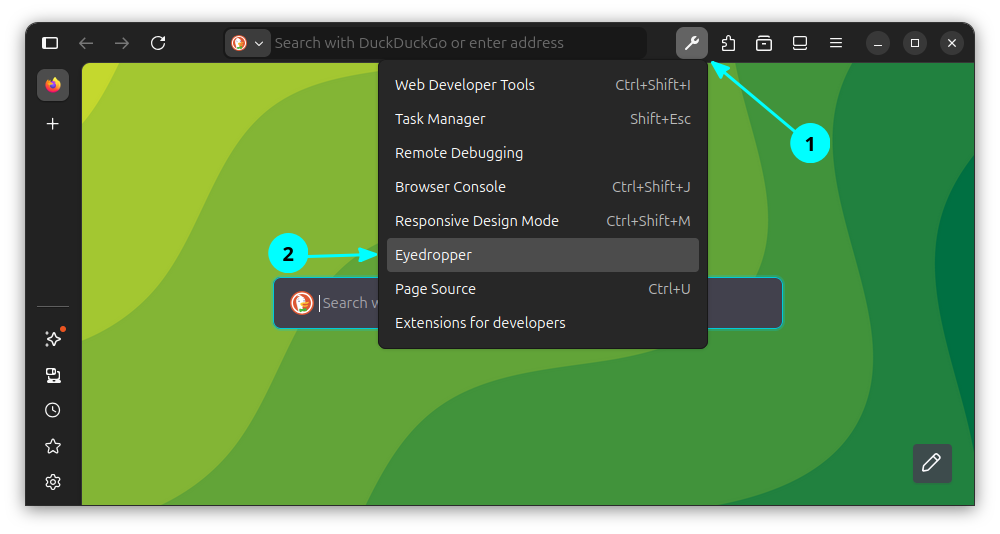
firefox eyedropper tool

You can also right-click on an empty place in the toolbar and select "Customize Toolbar..."

Here, drag and drop the "Developer" tool to the toolbar. Now, you can access the Eyedropper from this button as well.

🎋 Fun in the FOSSverse

A new fun quiz where you have to guess the fake distros that do not exist.

Oops, let me hide my pile of trash. 🫠

messy home directory linux meme

🗓️ Tech Trivia: On April 16, 1959, John McCarthy gave the first public presentation of LISP at MIT. The list-processing language he built from scratch became the foundation of artificial intelligence programming and introduced concepts like garbage collection still used today.

🧑‍🤝‍🧑 From the Community: One of our regular FOSSers has posted about Hardware Freedom Day 2026; are you celebrating?


✇It's FOSS

Can You Identify The Fake Linux Distros From The Real Ones?

Von: Abhishek Prakash

Not all distros are created equal.

In fact, not all distros are created at all.

This quiz is simple. You'll be presented with a few Linux distros and their details. The twist is that they might not be a real thing. They could just be a fragment of my imagination.

Of course, this is valid only at the time when I created this quiz. The way we move in Linux world, there could be some new distros coming up right after I publish this quiz 😃

🚧
Some browsers block the JavaScript-based quiz units. Disable your ad blocker to enjoy the quizzes and puzzles.

✇It's FOSS

FOSS Weekly #26.15: Rollback in apt, bad USB detection, Glass UI in KDE, Linux Kernel dropping older processor support and more

Von: Abhishek Prakash

Linus Torvalds created two of the most widely used tools in modern computing: the Linux kernel and Git.

Git, of course, is a version control system primarily used by programmers.

But Theena makes a strong case that Git and plain text are the best tools a writer can use. Not just for backup but for building a writing practice that is truly their own..

At its core, the argument is about breaking free from platform dependency, long-term preservation, and treating your body of work as something worth designing around rather than just storing somewhere convenient.

Here are other highlights of this edition of FOSS Weekly:

  • sudo tips and tweaks.
  • Apt's new version has useful features.
  • Opera GX arriving as a gaming browser for Linux.
  • A Linux driver proposal to catch malicious USB devices.
  • And other Linux news, tips, and, of course, memes!

Tired of AI fluff and misinformation in your Google feed? Get real, trusted Linux content. Add It’s FOSS as your preferred source and see our reliable Linux and open-source stories highlighted in your Discover feed and search results.

Add It's FOSS as preferred source on Google (if you use it)

📰 Linux and Open Source News

Not open source software but Opera GX, the gaming-focused Chromium browser that's been on Windows and macOS for years, has finally landed on Linux. Sourav took the early access build for a spin and tested the features it's known for, like GX Control for capping RAM and CPU usage while gaming and GX Cleaner for cleaning up junk data.

The Linux kernel is finally dropping i486 support, queued for Linux 7.1. The first patch removes the relevant Kconfig build options, with a fuller cleanup covering 80 files and over 14,000 lines of legacy code still to follow.

Proton has launched two new things: Proton Workspace, a bundled suite of all their services aimed at businesses looking for a privacy-first alternative to Google Workspace or Microsoft 365, and Proton Meet, an end-to-end encrypted video conferencing tool using the open source MLS protocol.

A proposal has been submitted to the Linux kernel mailing list for a new HID driver called hid-omg-detect that passively monitors USB keyboard-like devices for suspicious behavior.

Another proposal, but for Fedora was recently struck down. It looked to move per-user environment variable management from shell RC files into systemd.

Remember the glass UI from the Windows 7 era? KDE is considering bringing back the older classic Oxygen and Air themes. These themes will be optional, of course.

Anthropic, the company behind Claude AI, has donated $1.5 million to Apache Software Foundation. The donation aims to secure the open source stack AI tools depend on.

🧠 What We’re Thinking About

Firefox has been losing ground for a decade, and Mozilla is trying something new. A built-in VPN and a growing set of AI features. Roland's piece looks at whether either of those things is likely to actually work.

Puter, the open source browser-based desktop OS, has added ONLYOFFICE to its app marketplace, giving it a full office suite covering documents, spreadsheets, presentations, and PDF editing.

YOUR support keeps us going, keeps us resisting the established media and big tech, keeps us independent. And it costs less than a McDonald's Happy Meal a month.

Support us via Plus membership and additionally, you:

✅ Get 5 FREE eBooks on Linux, Docker and Bash
✅ Enjoy an ad-free reading experience
✅ Flaunt badges in the comment section and forum
✅ Help creation of educational Linux materials for everyone

Join It's FOSS Plus

🧮 Linux Tips, Tutorials, and Learnings

Not many people know that sudo command's behavior can be tweaked as well. Here are a few sudo tweaks.

Tennis is a Zig-written terminal tool that renders CSV files as clean, color-coded tables with solid borders and auto-detected themes.

APT package manager's latest version 3.2 has a rollback feature. Sourav briefly tested it.

📚 Linux eBook bundle (don't miss)

No Starch Press needs no introduction. They have published some of the best books on Linux. And they are running an ebook bundle deal on Humble Bundle.

I highly recommend checking it out and getting the bundle.

Plus, part of your purchase supports Electronic Frontier Foundation (EFF).

👷 AI, Homelab and Hardware Corner

The Linux kernel dropped i486 support and added GD-ROM driver support for the Sega Dreamcast in the same breath.

✨ Apps and Projects Highlights

Hideout is a minimal GTK4/Adwaita desktop app for file encryption and decryption, powered by GnuPG.

📽️ Videos for You

Here are some Linux terminal tricks to save you time.

💡 Quick Handy Tip

You can copy a file in Nautilus by pressing Ctrl+C, then press Ctrl+M to paste it as a symbolic link instead of an actual copy. This is a handy way to create a symlink without ever needing to open a terminal!

0:00
/0:15

🎋 Fun in the FOSSverse

In this members-only crossword, you will have to name systemd's ctl commands.

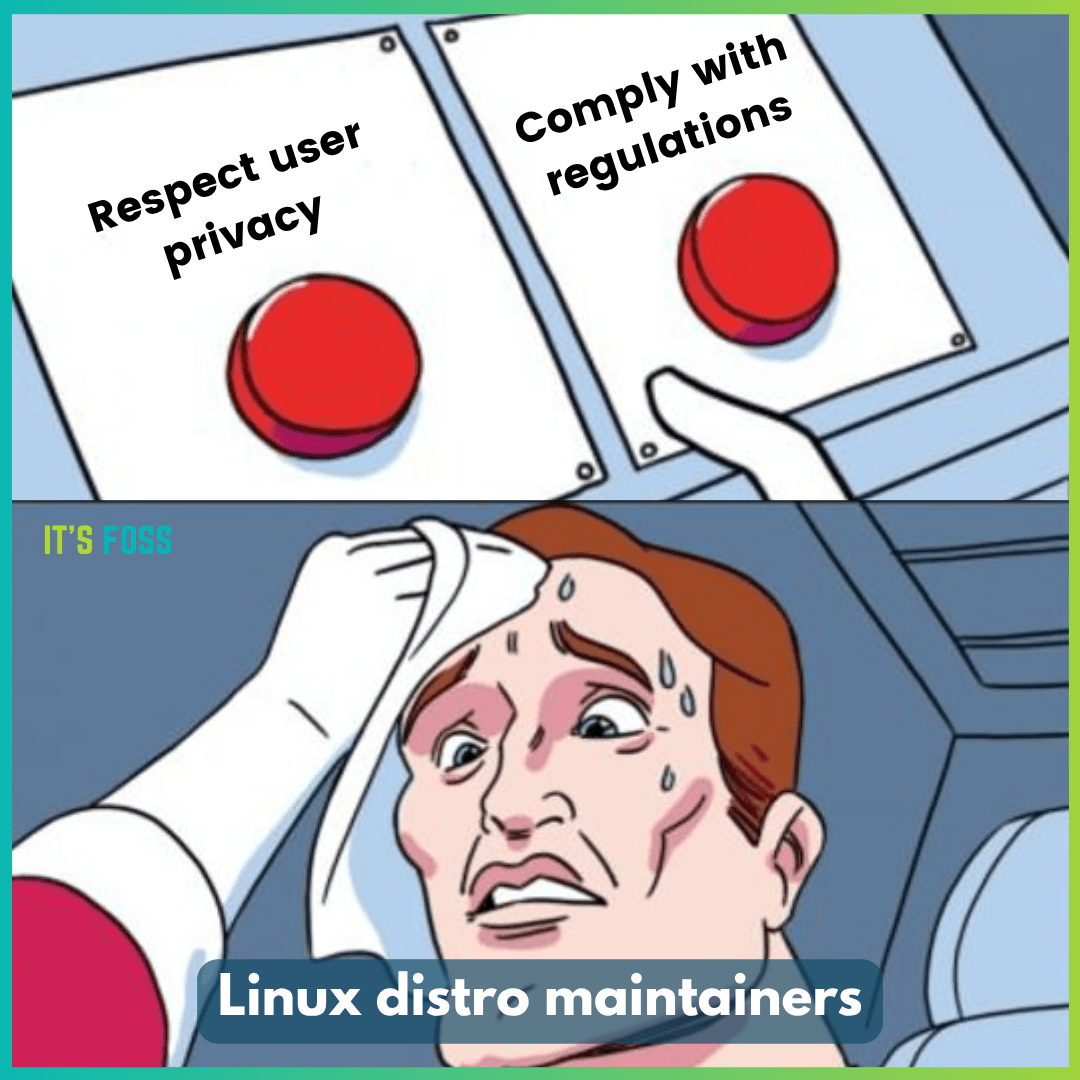
An appropriate meme on the OS-level age verification topic.

age verification and linux distro maintainers meme

🗓️ Tech Trivia: On April 8, 1991, a small team at Sun Microsystems quietly relocated to work in secret on a project codenamed "Oak", a programming language that would eventually be renamed Java and go on to become one of the most widely used languages in the world, powering everything from Android apps to enterprise software.

🧑‍🤝‍🧑 From the Community: A FOSSer is wondering if anyone has ever jailbroken a Kindle for KOReader use.

✇It's FOSS

FOSS Weekly #26.12: GNOME 50 Release, Fedora for Apple, New Ageless Linux, Manjaro Drama and More

Von: Abhishek Prakash

In the previous newsletter, I discussed how various distros are handling the age verification laws. At the end of the article, I speculated that we would see a few existing or new distros coming up with "no age verification" as their unique feature.

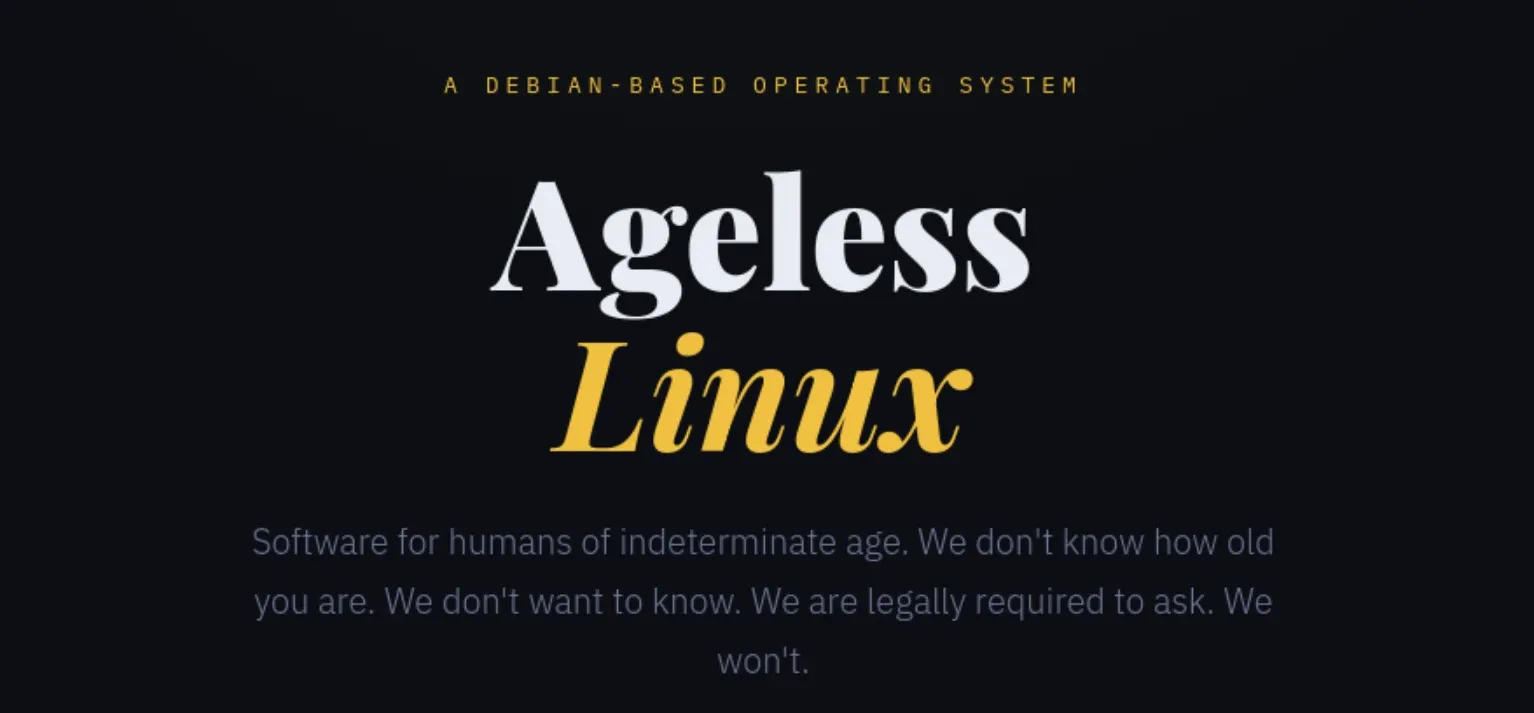
Guess what? We have a new distro called Ageless Linux which is created specifically to refuse compliance with OS-level age verification laws.

But it's more than just a distro; the project also maintains a tracker of where various distros and organizations stand on age verification and a $12 RISC-V hardware project aimed at putting non-compliant devices in the hands of schoolchildren. I am glad that it exists.

Here are other highlights of this edition of FOSS Weekly:

  • Things you can do Linux but not on Windows
  • Chrome on ARM Linux (aka Raspberry Pi).
  • A new web browser for Linux users.
  • GNOME 50 and Fedora Ashahi releases
  • And other Linux news, tips, and, of course, memes!

📰 Linux and Open Source News

GNOME 50 is here and X11 is not. Wayland is all the way in this new release. Upcoming distros like Ubuntu 26.04 and Fedora 44 will have it. Rolling distros like Arch should also get it soon.

Google has officially announced Chrome for ARM64 Linux, with a release targeted for Q2 2026. That means Raspberry Pi users, Snapdragon laptop owners, and anyone else running ARM hardware will get the Chrome experience on Linux.

Although, not open source, Kagi's Orion browser has made it to Linux as a public beta, and it's genuinely interesting because it's one of the browsers on the platform not built on Chromium or Firefox's engine. It is based on WebKit and works okayish on GNOME.

A significant chunk of the Manjaro team has gone public with the "Manjaro 2.0 Manifesto," signed by 19 members, calling for the project to separate from its parent company and restructure as a nonprofit.

Fedora Asahi Remix 43 arrives with Mac Pro support. In case you did not know, Asahi is the project bring Linux to Apple's Silicon processors.

AI companies like Anthropic, OpenAI, Meta etc have put $12.5M into Open Source Security, managed by Linux Foundation. This is funny in a way. They are putting together a fund to fix the problem their AI tools created in the first place.

🧠 What We’re Thinking About

Google wants every Android developer to register using their real identity before their apps will install on certified devices, but not everyone's on board.

YOUR support keeps us going, keeps us resisting the established media and tech, keeps us independent. And it costs less than a McDonald's Happy Meal.

Opt for the Plus membership to:

✅ Get 5 FREE eBooks on Linux, Docker and Bash
✅ Enjoy an ad-free reading experience
✅ Flaunt badges in the comment section and forum
✅ To support creation of educational Linux materials

Join It's FOSS Plus

🧮 Linux Tips, Tutorials, and Learnings

A clean beginner's guide to Markdown covering the core syntax: headings, text formatting, links, images, lists, and block quotes. It comes with a downloadable cheat sheet and a few recommendations for online editors if you want to try it without installing anything.

Windows users have been conditioned to ask, "But can Linux do X?" This piece by Roland flips it around and asks what Linux can do that Windows can't. The answers range from practical (live sessions, moving installs between machines, reviving old hardware) to genuinely impressive (swapping kernels, choosing filesystems, replacing every layer of your stack).

📚 eBook bundle on AI

Inside this 20+ eBook library, you’ll gain expert insights from practical lessons like Learn Python Programming, 4E and the LLM Engineer's Handbook. These massively efficient tools save you time and effort so you can prioritize other important tasks and systems.

Your purchase supports the World Central Kitchen organization.

👷 AI, Homelab and Hardware Corner

If your Raspberry Pi homelab is freezing up under load, the default 200 MB swap is probably the first thing worth looking at.

✨ Apps and Projects Highlights

If your GNOME top panel has turned into a wall of icons, Veil is worth a look. It's a shell extension that lets you hide panel items behind a toggle arrow.

📽️ Videos for You

You could move away from Google today if you wanted to, and DuckDuckGo is one of the good ones to consider.

💡 Quick Handy Tip

In Nautilus file manager, you can press CTRL+F to start a search in the current directory and CTRL+SHIFT+F to search across the other system folders. To go even further, you can add new search locations via the Search settings.

0:00
/0:14

And, if you use the shortcut CTRL+ALT+O after selecting a file or folder, you can go to it's location in the file manager. Do note that this works in the Search and Recent pages of the file manager.

🎋 Fun in the FOSSverse

Do you know the brain behind Debian? This Ian Murdock quiz will test your knowledge.

🤣 Meme of the Week: We must protect it at all costs!

man page meme

🗓️ Tech Trivia: On March 17, 1988, Apple sued Microsoft for copyright infringement over the look and feel of the Windows GUI. Apple's argument was that Windows borrowed too heavily from the Macintosh interface it had debuted in 1984. The case dragged on for years before a judge ruled that Apple had only limited rights to the design elements in question.

🧑‍🤝‍🧑 From the Community: One of our regular Pro FOSSers is having an issue with CUPS on antiX Linux; can you help?

FOSS Weekly #26.12: GNOME 50 Release, Fedora for Apple, New Ageless Linux, Manjaro Drama and More

✇It's FOSS

Ageless Linux Emerges to Protest OS-Level Age Verification Laws

Von: Abhishek Prakash

A new Linux distro has appeared.

Not surprisinhg. We get new Linux distributions almost every month, sometimes even every week.

This one is based on Debian. Again, not surprising. Debian has long been the mother of countless Linux distros.

But the interesting part isn’t the base. It’s the reason this distro exists.

It was created as a symbol of resistance.

That’s also not new in the Linux world. Many distros have been born out of disagreement or protest. For example, Void Linux emerged during the heated systemd controversy, offering a system that avoided systemd entirely.

The new distro, called Ageless Linux, follows a similar idea. It’s essentially Debian Linux but without age verification.

Age verification… what?

A new trend is quietly spreading across the United States: laws that require age verification at the operating system level.

It started with California, and states like Colorado, New York, and Illinois have proposed similar legislation. Reports also suggest that Brazil may be moving in the same direction.

What makes this development even more interesting is that Meta, the company behind Facebook, reportedly lobbied heavily for these laws.

Until now, governments mainly pressured social media platforms to verify users’ ages to prevent young children and teenagers from accessing certain services.

Meta’s proposal shifts that responsibility. Instead of every app or website verifying a user’s age individually, the operating system would verify it once.

Then, through an API exposed by the OS or its app store, applications could simply ask the system for the user’s age or age category.

In other words, your operating system becomes the age gatekeeper for every app you install.

And that idea has sparked a lot of debate in the tech community especially among Linux and open-source developers.

Why age verification is 'incompatible' with Linux ecosystem?

At first glance, age verification sounds reasonable. Governments argue that it helps protect children from harmful online content. But many developers and privacy advocates see serious problems with pushing this responsibility to the operating system.

The biggest concern is privacy. Linux distributions traditionally collect little to no personal information about users. Unlike Apple and Microsoft, you are not forced to create an online account before using an operating system. Introducing age verification could mean that operating systems must store or process sensitive identity data, something many Linux projects have deliberately avoided for decades.

Some critics suspect the push is less about child safety and more about control, warning that once operating systems begin verifying identity or age, it becomes easier to expand such systems to regulate broader online activity.

Another issue is security risk. If operating systems start storing age or identity information, it creates a new type of data that could potentially be misused, leaked, or exploited. Even if only age categories are shared with apps, it still introduces a form of system-level user profiling.

There is also a philosophical concern. Many of us in the open-source world believe an operating system should remain a neutral tool, not a platform that enforces identity verification or government regulations.

Because of these concerns, some developers and users see OS-level age verification as a step toward turning operating systems into identity gatekeepers, which runs against the long-standing Linux ethos of user freedom and minimal to no data collection.

Ageless Linux

Unsurprisingly, the age-verification proposal has raised serious discussions in the open-source world. From what it seems, most mainstream distros will enable this feature in one way or another. That includes Debian.

I anticipated this situation. I had a feeling that there would be some new distros offering “no age verification” as their main feature.

That’s precisely what Ageless Linux has done.

Ageless Linux

The project positions itself as a statement against OS-level age verification. Instead of building systems that identify and categorize users by age, Ageless Linux sticks to a much simpler idea: an operating system should run software, not act as a digital identity checker.

Ageless Linux is a registered operating system under the definitions established by the California Digital Age Assurance Act (AB 1043, Chapter 675, Statutes of 2025). We are in full, knowing, and intentional noncompliance with the age verification requirements of Cal. Civ. Code § 1798.501(a).

In practical terms, Ageless Linux is basically Debian with the age-verification pieces removed or avoided. The goal isn’t to reinvent Linux, but to ensure that users who oppose these laws still have a distribution that does not participate in age-verification frameworks.

More than just another Linux distro actually

I am glad that Ageless Linux did not stop at "Debian without age verification". Browsing the website, it seems they are more of a project that stands against age verification.

They have a dedicated page, and hopefully a database in the future, that lists the stance of various distros and organizations on the age verification issue. There is a page that lists US state laws that require operating system providers to collect age data from users.

So it’s not just a distro; it’s becoming a full-fledged portal documenting and opposing age-verification laws.

In addition to that, they also have an ambitious hardware project that is "designed to satisfy every element of the California Digital Age Assurance Act's regulatory scope while deliberately refusing to comply with its requirements."

This hardware is basically a $12 RISC-V ARM board. They have named it "Ageless Device" and the aim is to give it to children in schools.

And I’m glad they are not restricting themselves to just a distro, but are moving toward becoming a non-profit organization that educates people about the potential dangers of age verification turning into surveillance infrastructure.

Do check them out.

Ageless Linux Emerges to Protest OS-Level Age Verification Laws

✇It's FOSS

Good News! Google Chrome on Linux is Getting the Much Awaited Upgrade

Von: Abhishek Prakash

Here is the big news. Google plans to bring its flagship Chrome browser for ARM64 Linux devices. The release is set for the second quarter (April-June) of 2026.

Which means you should be able to use Google Chrome on Raspberry Pi and other single board computers and laptops with Snapdragon processors.

Google highlighted this in the announcement:

Launching Chrome for ARM64 Linux devices allows more users to enjoy the seamless integration of Google’s most helpful services into their browser. This move addresses the growing demand for a browsing experience that combines the benefits of the open-source Chromium project with the Google ecosystem of apps and features.

But there is Chromium available already

Many FOSS purists prefer Chromium over Chrome, as it is the open-source project that serves as the foundation for Google Chrome. In fact, many Linux distributions, even on non-ARM devices, ship Chromium as the default browser.

However, Chromium is not the same as Chrome. DRM playback support is often limited, Google account sync typically requires workarounds to function properly, and several proprietary features are missing. It is undoubtedly a solid browser, but it doesn’t offer the same level of mainstream convenience and integration that users are accustomed to with Google Chrome.

Took a real long time due to Google's apathy towards Linux

Chromium has been available for ARM devices for years but Google did not care for offering Chrome for Linux users. Emphasizing on Linux because Google quickly released Chrome for Apple's ARM devices in 2020 itself and it was followed by Windows ARM devices in 2024.

This is when Chromebook with ARM perocessors have been in existence since 2012. Google's Chromebook run a cutsomized version of Linux in the form of ChromeOS. And these Chromebooks had Chrome browser. Surely, not much was required for bringing Chrome to Linux ARM devices.

Thank you, NVIDIA?

The announcement blog has an interesting mention of NVIDIA.

Last year, NVIDIA introduced the DGX Spark, an AI supercomputing device that packs its Grace Blackwell architecture into a compact, 1-liter form factor. Google is partnering with NVIDIA to make it easier for DGX Spark users to install Chrome.

So, was it NVIDIA who pushed/inspired Google to work on bringing Chrome to Linux ARM devices? Maybe.

Source: Chromium blog

Good News! Google Chrome on Linux is Getting the Much Awaited Upgrade

✇It's FOSS

FOSS Weekly #26.11: SUSE for Sale, Firefox Redesign, New-ish Terminal, i3 Customization and More

Von: Abhishek Prakash

If rumors and Reuters are to be believed, SUSE Linux us up for sale again. Again because it has changed owners several times in the past. IBM bought Red Hat Linux for $34 billion 6 years ago. It would be interesting to see who grabs SUSE. I hope it's not Microsoft.

By the way, not seeing new articles from It's FOSS in your feed reader? That's because there is an ongoing issue with the RSS feed as I am migrating to FeedPress. Please bear it with me.

Here are other highlights of this edition of FOSS Weekly:

  • EA slowly moving towards Linux.
  • Firefox's redesign has been leaked.
  • Linux Mint keyboard shortcut video.
  • MidnightBSD saying no to age verification.
  • And other Linux news, tips, and, of course, memes!

📰 Linux and Open Source News

EA is hiring an anti-cheat engineer to bring Javelin to ARM64, and tucked into the job listing is a mention of exploring Linux and Proton support in the future. After ditching Linux for Apex Legends in 2024, it's a surprising turn. But I wouldn't hold my breath on this.

Firefox's Proton UI has been around since 2021 and honestly looks it. Leaked internal mockups show Mozilla is working on something called "Nova," a significant visual overhaul. Tabs, the address bar, and the toolbar are merged into a single floating strip; rounded corners are everywhere; flat grays are out in favor of gradients, and the private window gets a full dark-purple makeover.

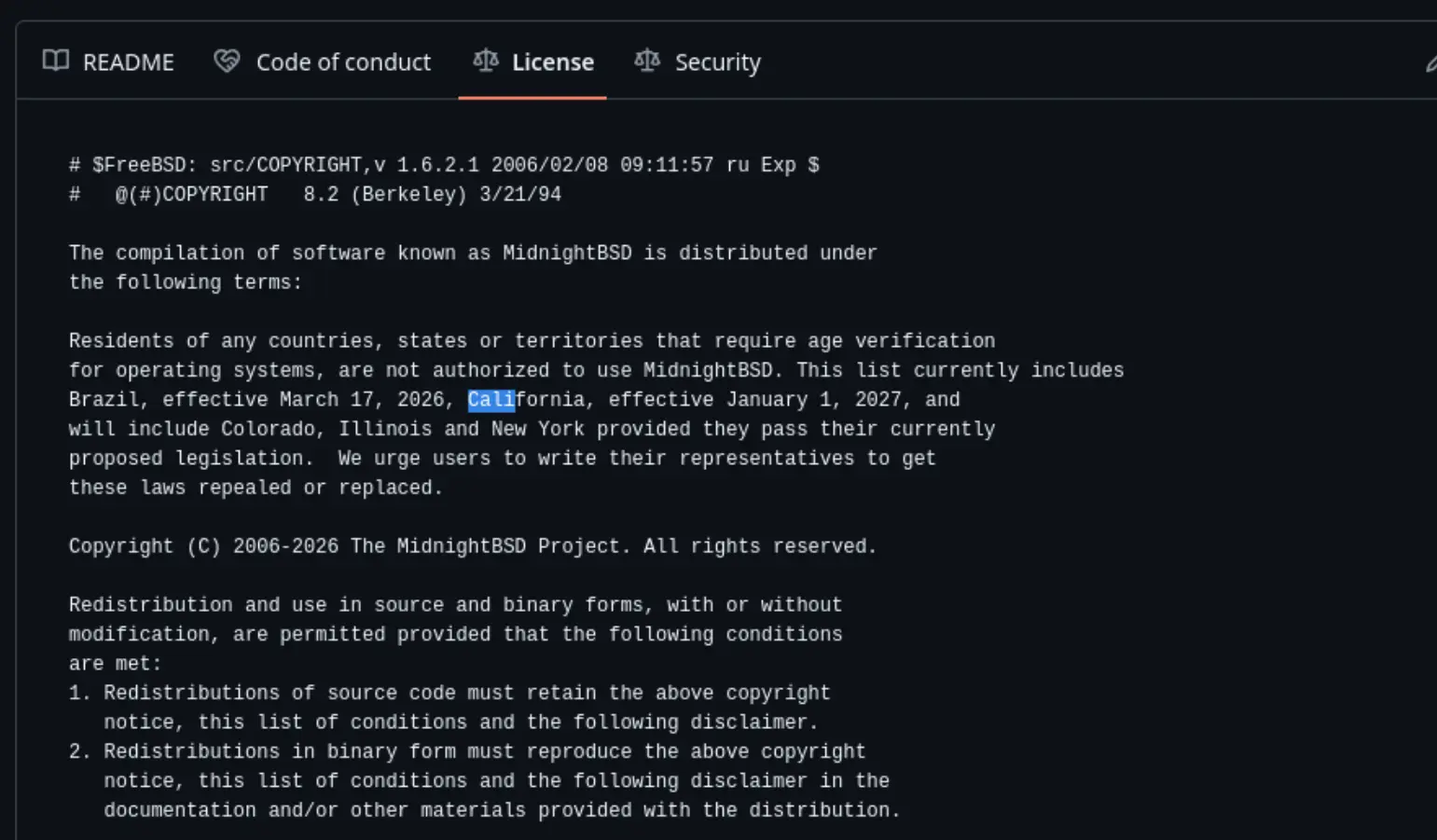
MidnightBSD has updated its license to bar residents of Brazil and California from using the project, with Colorado, Illinois, and New York on the list if their respective pending age verification bills pass.

🧠 What We’re Thinking About

The age verification laws spreading across US states are making distro maintainers uncomfortable, and responses are all over the place. Ubuntu and Fedora are working on minimal local APIs to tick the compliance box without doing anything too invasive. MidnightBSD is outright banning people from using it (as mentioned above).

YOUR support keeps us going, keeps us resisting the established media and tech, keeps us independent. And it costs less than a McDonald's Happy Meal.

Opt for the Plus membership to:

✅ Get 5 FREE eBooks on Linux, Docker and Bash
✅ Enjoy an ad-free reading experience
✅ Flaunt badges in the comment section and forum
✅ To support creation of educational Linux materials

Join It's FOSS Plus

🧮 Linux Tips, Tutorials, and Learnings

Wordcloud is a Python tool that turns any list of words into a visual word cloud image, right from the terminal. You can feed it a text file, tweak the resolution, swap the font, change the background color, or use a mask image to shape the output around a custom silhouette.

Some practical privacy tips that don't require a computer science degree or a paranoia spiral. Our article covers the basics well, from securing your email and browser to picking better cloud storage and messaging apps.

Ever wanted a desktop that looks like it belongs on r/unixporn? We have an i3 customization guide that covers a lot, from basic keybindings and color schemes to transparent status bars and per-workspace app assignments.

GSConnect is the GNOME-friendly way to link your Android phone and Linux machine, built on top of KDE Connect. Once paired, you can transfer files, share the clipboard, get phone notifications on your desktop, and use your phone as a remote mouse.

👷 AI, Homelab and Hardware Corner

Prefer your local AI neatly containerized? This guide shows how to get Ollama running in Docker.

✨ Apps and Projects Highlights

FRANK OS is a full desktop operating system, complete with a Start menu, overlapping windows, Alt+Tab switching, and a ZX Spectrum emulator, running on an RP2350 microcontroller.

Foot is a minimal Wayland-native terminal emulator that focuses on speed and simplicity. A hidden gem worth exploring.

Keith Curtis spent a week building what he calls "Cursor for LibreOffice," an AI extension that lives in a sidebar and actually edits your documents.

Building Cursor for LibreOffice: A Week-Long Journey

📽️ Videos for You

Sharing some of the essential keyboard shortcuts for Linux Mint, this time in video format.

💡 Quick Handy Tip

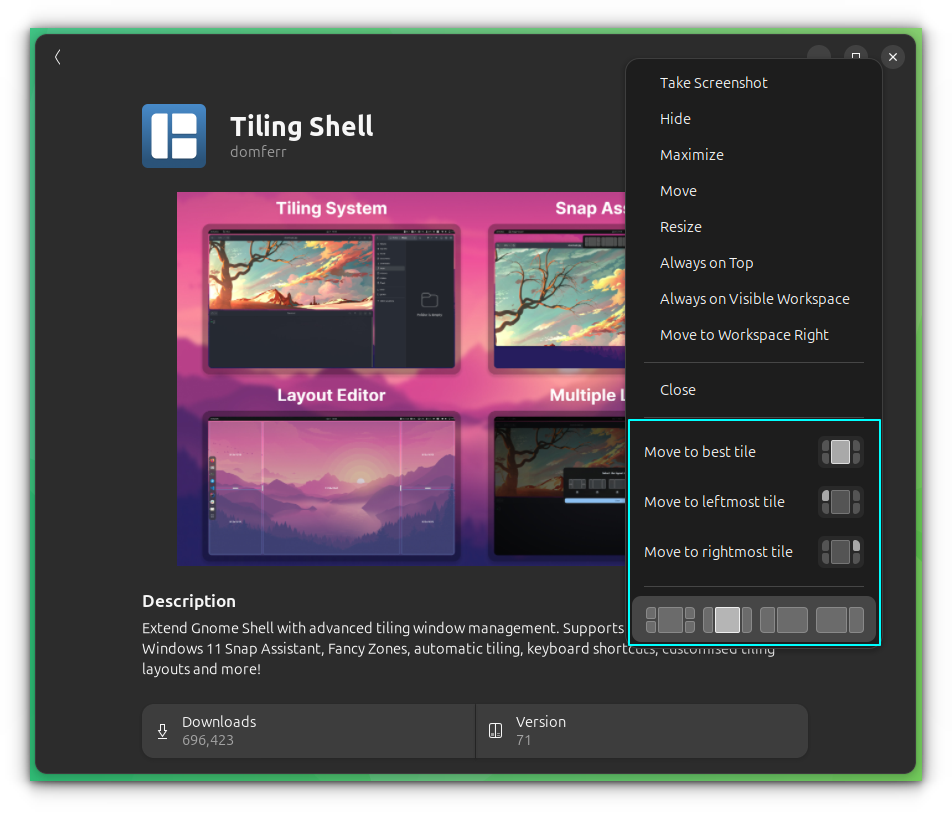
On GNOME, first install Tiling Shell. Then, when you right-click on the titlebar of a window, you get various tiling options. Do keep in mind that not all apps will support this.

gnome tiling shell extension window tiling

🎋 Fun in the FOSSverse

Match Linux apps with their functions in this puzzle. And yes, fresh new puzzles are coming soon 😄

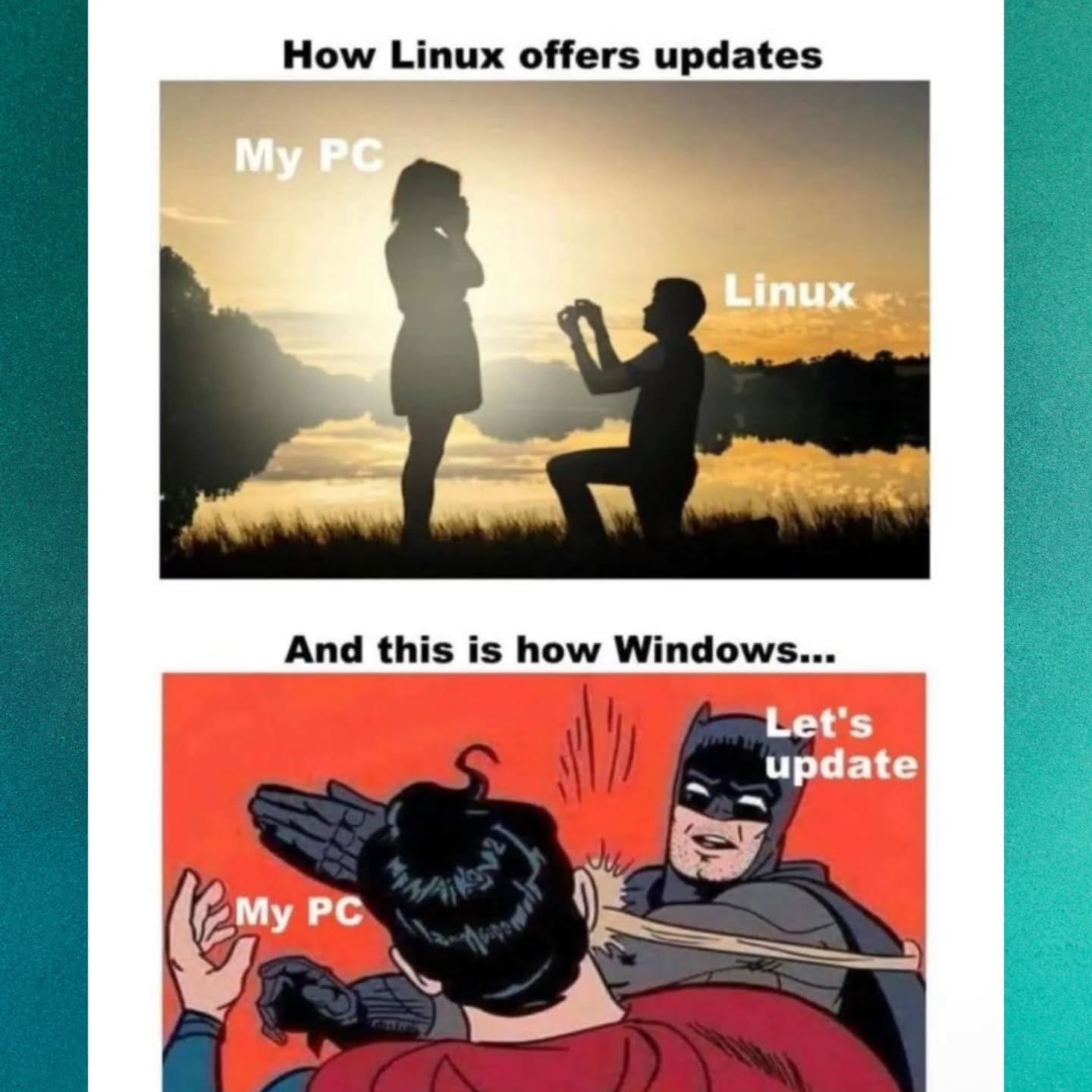
🤣 Meme of the Week: Winslop doesn't know what consent means.

linux and windows update comparision meme

🗓️ Tech Trivia: On March 9, 1955, a program called "Director" was demonstrated on MIT's Whirlwind computer—automatically managing system resources while user code ran. It's considered one of the earliest rudimentary operating systems ever created.

🧑‍🤝‍🧑 From the Community: Can you help one of our regular FOSSers decide whether to keep Secure Boot enabled or not?

FOSS Weekly #26.11: SUSE for Sale, Firefox Redesign, New-ish Terminal, i3 Customization and More

✇It's FOSS

Looks Like SUSE Linux is Up For Sale (Again)!

Von: Abhishek Prakash

If Reuters report is to be believed, SUSE Linux is again up for sale in the market with a price tag of $6 billion.

This is about enterprise-oriented SUSE Linux. openSUSE, on the other hand, is community-managed but heavily funded by SUSE. I like to think of SUSE Linux as Red Hat and openSUSE as Fedora.

So any decision taken by SUSE Linux impacts openSUSE, more directly than indirectly. We will have to see what direction it takes if SUSE is sold again.

Notice how I am reusing the word 'again'? That's because this is not the first time SUSE Linux has been sold.

Long history of changing hands

SUSE was founded in 1992 and provided the distribution along with support and services to enterprises. In fact, it was the first company to market Linux to enterprises.

It was first purchased by Novell in 2004 for $210 millions. Novell did put a lot of effort in popularizing Linux, pitching it against Windows and Apple. They even ran ads that some veteran Linux users might remember.

It was a good run until Attachmate purchased Novell in 2011 for a hefty $2.2 billion. SUSE was part of Novell and thus Attachmate took the ownership of the project.

And then in 2014, Micro Focus acquired Attachmate for $2.35 billion and thus once again SUSE saw a new owner.

Come 2018 and a private equity group EQT bought Micro Foucs for $2.535 billions. Needless to say, SUSE was part of the deal.

Except for the first one, the rest of the deals were for the parent company, not necessarily for SUSE. However, the current report suggests that EQT is only selling SUSE this time for approximately $6 billion.

📜
SUSE launched an IPO in 2021 but went private again in 2023 under EQT ownership.

Red Hat went for $34 billions

Red Hat is often considered SUSE’s closest competitor, as both primarily focus on enterprise customers. In 2019, IBM acquired Red Hat for $34 billion, making it one of the largest software acquisitions in history. Since then, Red Hat has become a central pillar of IBM’s hybrid cloud strategy, helping drive growth in areas where IBM had been struggling to maintain momentum.

Who could buy SUSE?

We can only guess, and if it were up to me, here are a few big names that could take advantage of SUSE:

  • Amazon: Although Amazon has its own Linux distros for deploying AWS internally
  • IBM: It already has Red Hat in its kitty. Getting SUSE means near monopoly in enterprise Linux. But this could also be blocked by regulators.
  • Oracle: Oracle has its own Oracle Linux for enterprise. With SUSE, it can expand its business.
  • Broadcom: They have already gotten VMWare and thus they already have one foot in the enterprise Linux market. With SUSE, they will only consolidate their position.
  • Microsoft: They have Azure but that's primarily for cloud servers. For a company like Microsoft, $6 billion is not a huge amount. They can expand their enterprise offering with SUSE.

These are all guesses. For all we know, an unknown player could enter the scene, or it might not be sold at all.

Your turn now. What do you think of SUSE being in the market again. Which company should buy it?

Looks Like SUSE Linux is Up For Sale (Again)!

✇It's FOSS

How Linux and BSD Distros Are Responding to the New Age Verification Laws

Von: Abhishek Prakash

The US states of California, Colorado and Illinois are passing new age verification laws that require operating systems, including Linux and BSD distributions, to implement age attestation during account setup and provide an API for apps to query user age brackets.

This is 'intended to help' apps filter content for minors, but it relies on self-reported ages without mandatory ID checks. Similar proposals exist in New York and Brazil.

While enforcement on community-driven distros remains unclear, several have begun addressing the laws through compliance planning, rejection, or exclusion strategies.

Here's the situation so far.

Some distros are planning to comply

Canonical, the company behind Ubuntu, is reviewing the legislation with legal counsel but has not announced concrete changes yet. Community developer discussions include proposals for an optional D-Bus interface (org.freedesktop.AgeVerification1) to handle age brackets locally without privacy-invasive telemetry, potentially influencing other distros if adopted.

Aaron Rainbolt, Ubuntu Community Council Member and contributor to Whonix, said:

We're currently looking into how to implement an API that will comply with the laws while also not being a privacy disaster...

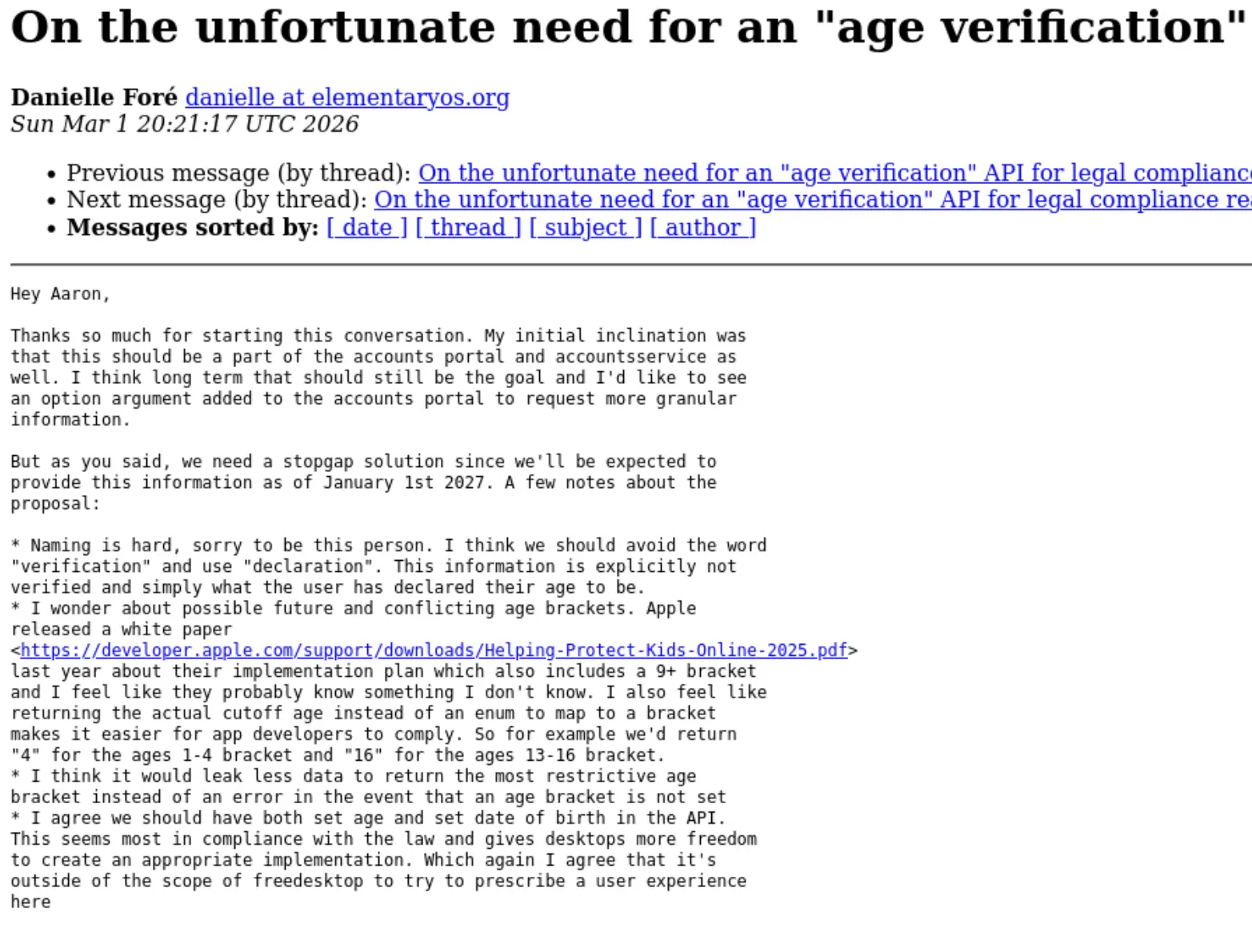
elementary OS seems to be relying on Ubuntu's implementation too. Danielle Foré, elementary's lead developer and founder, was also in the same discussion expressing their willingness to address the issue before the law comes into effect.

elementary OS seems to be relying on Ubuntu's implementation

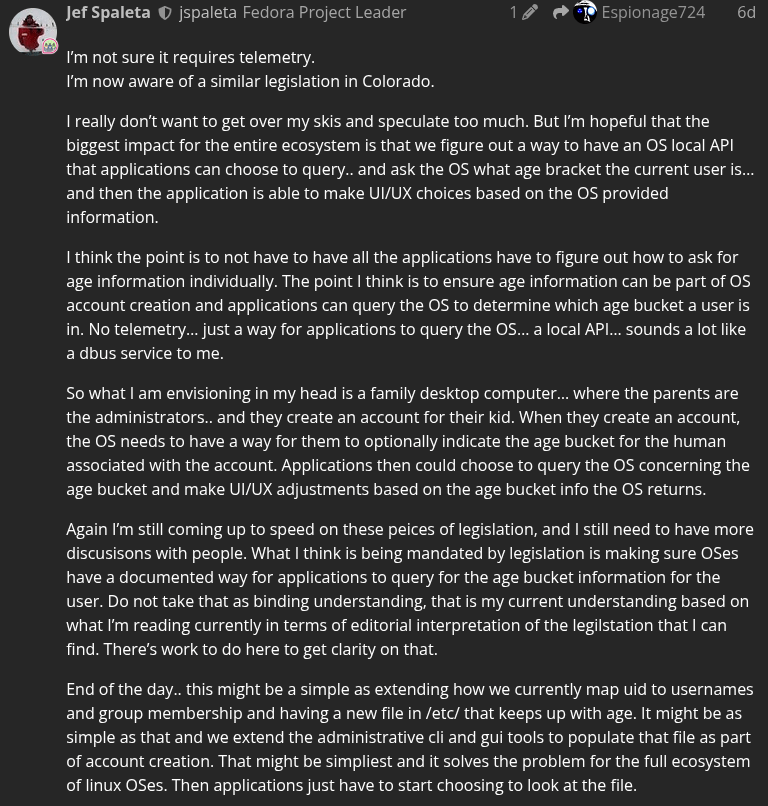
The Fedora community is exploring non-intrusive implementations, such as a local API or an /etc/ file populated during setup to provide age brackets to apps without online verification or data sharing. Former project leader Jef Spaleta mentioned that it is not telemetry but a minimal adjustment to meet legal requirements.

Fedora devs discussing the age verification

System76, Linux system manufacturer and the company behind Pop!OS, noted that the laws do not mandate robust verification, only self-attestation and warned that non-compliance could lead to restricted app access for users. They are also considering minimal changes to provide age signals, focusing on avoiding unintended consequences like a "nerfed internet."

If there is any solace in these two laws, it’s that they don’t have any real restrictions. There is no actual age verification. Whoever installed the operating system or created the account simply says what age they are. They can lie. They will lie. They’re being encouraged to lie for fear of being restricted to a nerfed internet.

Some distros are resisting

The bold step came from DHH and his Omarchy Linux as it outright rejected compliance, with DHH stating that he had no plans to respond to the "retarded" California law.

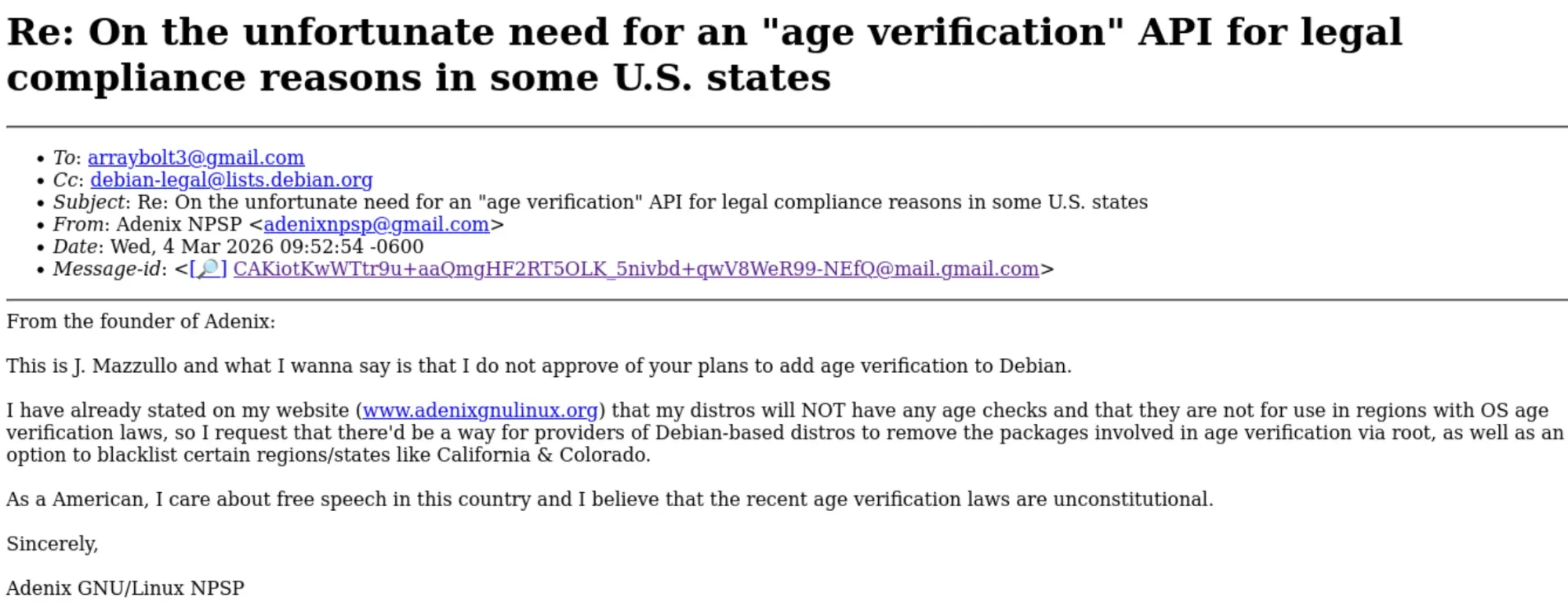
Adenix GNU/Linux distro has declared it will not implement age checks, aligning with a principled stand against such requirements.

Age verification law resistance

MidnightBSD has taken a firm stance against compliance by updating its license to explicitly exclude California residents from using it for desktop purposes starting January 1, 2027. The project's lead stated this is a temporary measure until a better solution emerges, emphasizing the impracticality of age verification for open-source OSes.

MidnightBSD age verification stance

What about the rest?

There are no official statements from Linux Mint yet, so any conclusion here is merely speculative. Given its close alignment with Ubuntu, I think it will follow whatever direction Ubuntu takes, possibly adopting the same shared API approach.

Arch Linux has remained publicly silent on the issue as well. Some forum discussions briefly appeared in my web search results but they seem to be removed, leaving no clear indication of the project’s stance. SUSE has also not made any public comments so far. Since the legislation originates in the U.S., European-focused distributions like SUSE may not feel immediate pressure to respond.

Meanwhile, discussions in the NixOS community suggest that they are waiting to see what larger distributions decide. That is not surprising. Much of the Linux ecosystem ultimately traces back to Debian, Arch, Ubuntu, and Red Hat (Fedora). Whatever technical approach these major players adopt will likely influence dozens of downstream distributions.

And we should also see a few existing or new distros coming up with "no age verification" as their unique feature that distinguishes them from the rest. After all, Linux community is known to take a stance, right?

How Linux and BSD Distros Are Responding to the New Age Verification Laws

✇It's FOSS

FOSS Weekly #26.10: Age Verification in Linux, systemd Troubleshooting Tools, Graphene Phone, Longer Linux LTS Kernels and More

Von: Abhishek Prakash

U.S. states keep passing age-verification laws that sound reasonable until you read the fine print. Colorado, for example, wants operating systems to broadcast age data to every app you install, and California has already passed a similar bill.

As governments push age checks deeper into apps and operating systems, what once sounded like a safety measure is starting to feel a lot like surveillance.

And it’s not just happening in the U.S. Reports suggest Brazil is also moving toward similar regulations. While this model may fit ecosystems like Apple and Microsoft, where operating systems are tightly tied to online accounts, the Linux world works very differently. Yet developers from projects like Fedora and Ubuntu are already discussing how such requirements might affect Linux.

We’ll be keeping close eye on how this evolves. Stay tuned.

Here are other highlights of this edition of FOSS Weekly:

  • Longer support for certain Linux kernels.
  • systemd troubleshooting tools
  • Xfce customization.
  • Microsoft hates Microslop.
  • LibreOffice quick tip.
  • A new consortium to unify the Arm software ecosystem.
  • And other Linux news, tips, and, of course, memes!
SPONSORED

AI coding assistants write code fast but do they pick safe dependencies? This is where Sonatype Guide comes in. It connects tools like Cursor, Copilot, and Claude Code to real-time open source intelligence via MCP, so vulnerable packages get flagged before they land in the open source project. Try it here.

Try it here

📰 Linux and Open Source News

The web's most popular UI library has outgrown Meta's ownership. React is now part of the Linux Foundation with neutral governance and eight platinum members on board. Technical decisions are independent from the board, of course.

Arm software got too complex for any one company to handle alone. CoreCollective just launched to fix that fragmentation problem. Free membership for anyone building on Arm. AMD, Google, Microsoft and Red Hat are already in.

LTS kernel support windows just got extended after being cut to two years back in 2023. Linux 6.6 and 6.12 now get four-years of support instead. Greg Kroah-Hartman updated the schedule after discussions with companies and maintainers.

AI's RAM appetite just killed another hardware project. Orange Pi and Manjaro spent two years building a Linux gaming handheld, cleared regulatory approvals, and got everything ready to ship. Now it's sitting on ice because DDR5 chip prices are absurd.

Motorola just partnered with the GrapheneOS Foundation, and it was announced at MWC 2026. The two plan to collaborate on research, software improvements, and new security features in the coming months. If you did not know already, Graphene is an Android distribution that ditches Google's data collection layer entirely and has long been the go-to for anyone serious about privacy.

And a funny thing happened this week when Microsoft locked down its Discord server because people kept on calling it Microslop.

🧠 What We’re Thinking About

Few Linux distributions attract as much criticism as Ubuntu. From Snap complaints to Canonical decisions, the internet seems to have a long list of reasons to dislike it. But Ubuntu may not deserve nearly as much hate as it gets.

AI may not need your attention, but us humans do. YOUR support keeps us going. And it costs less than a McDonald's Happy Meal.

Opt for the Plus membership to:

✅ Get 5 FREE eBooks on Linux, Docker and Bash
✅ Enjoy an ad-free reading experience
✅ Flaunt badges in the comment section and forum
✅ To support creation of educational Linux materials

Join It's FOSS Plus

🧮 Linux Tips, Tutorials, and Learnings

When stuff breaks on Linux, systemd already knows what happened. Systemctl shows which services crashed, journalctl has the error messages, and systemd-analyze tells you what's hogging boot time. Coredumpctl keeps snapshots of apps that died completely.

Got an old PC or Raspberry Pi collecting dust? Batocera, Lakka, and RetroPie turn them into plug-and-play retro consoles via USB or SD card.

A quick tip if you love to use LibreOffice. If a document has way too many images and you have to save multiple or all images from it, save it as an HTML document in a new folder. You'll get all the images from the document. Pretty neat 😄

By the way, we are working on a "Linux Mint Starter Pack" series for beginners. I'll share with you when it is done. In the mean time, you can get familiar with the Linux command line.

👷 AI, Homelab and Hardware Corner

Tired of feeding your photos to Google's AI? PhotoPrism runs locally on Docker, handles face recognition and tagging on your hardware.

✨ Apps and Projects Highlights

A Czech-based dev built a data center sim where you rack servers and run cables. No native Linux support but works with some FPS issues

📽️ Videos for You

Xfce can be customized to look (more) beautiful. This video shows how:

💡 Quick Handy Tip

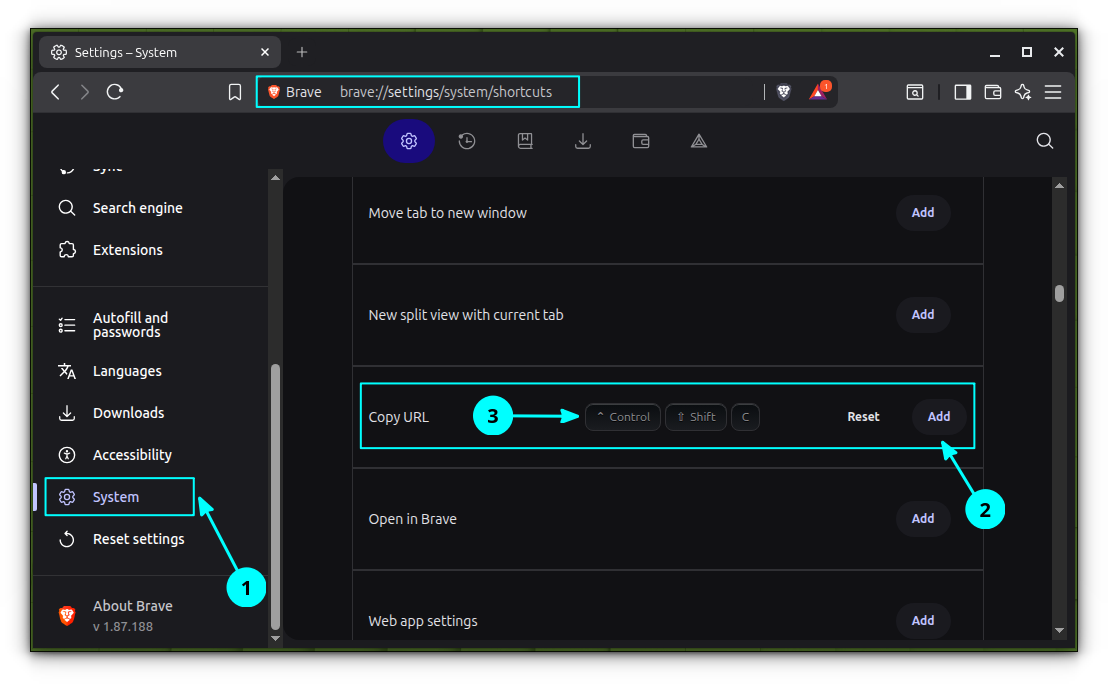
Brave browser allows you to set a shortcut to copy the URL of the current tab. For this, go to Brave Settings -> System -> Shortcuts. Here, search for Copy URL and add a keybind to it.

brave browser copy url shortcut

In the screenshot above, CTRL+SHIFT+C is added as the shortcut. This overwrites the default inspect function, which it was mapped to earlier. So tread with caution and try to add a non-conflicting shortcut.

If your browser does not support this, you can use CTRL+L to access the address bar and then CTRL+C to copy the URL of the current tab.

📚 Don't Miss! Linux eBook bundle

Humble Bundle has brought back the "Linux for Seasoned Admins" ebook bundle offer (partner link). From the classic Linux Pocket Guide and my favorite, Efficient Linux at the Command Line, the bundle also has ebooks on Docker, Ansible, Kubernetes and other devops aspects of Linux.

And your purchase also supports the Code for America initiative.

🎋 Fun in the FOSSverse

Can you beat this crossword and become the Daemon Hunter?

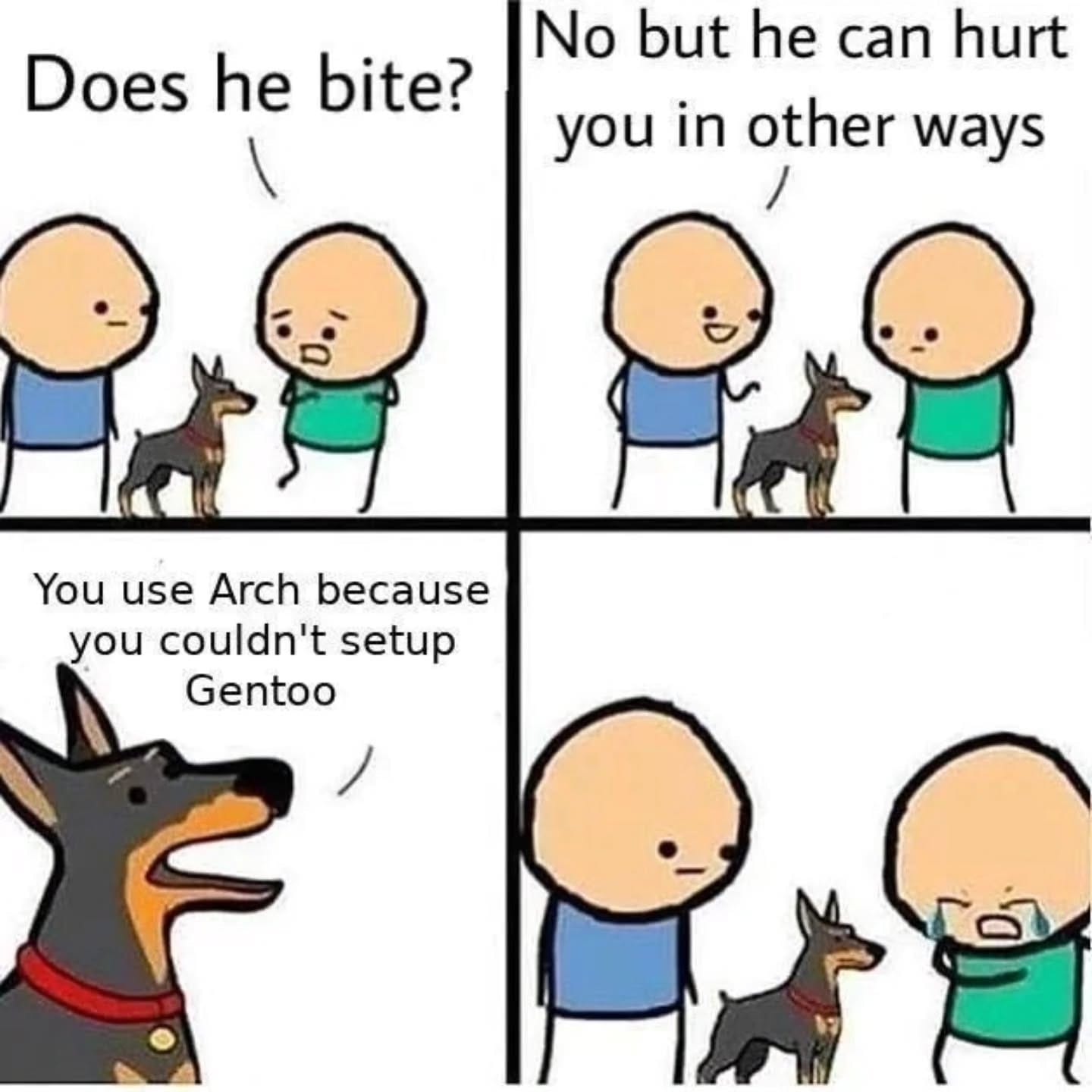
🤣 Meme of the Week: The pain is real. 🥲

arch gentoo meme

🗓️ Tech Trivia: On March 1, 1960, the first LISP Programmer's Manual was released by John McCarthy's group at MIT. McCarthy had built a recursive, symbolic language that would go on to become the foundation of AI programming and outlast nearly every other high-level language of its era.

🧑‍🤝‍🧑 From the Community: FOSSers are talking about the upcoming secure boot changes, and how it might affect those on Linux.

✇It's FOSS

FOSS Weekly #26.09: Linux Mint Shortcuts, OpenClaw Alternatives, Ladybird's Rust Move, Super Productivity and More

Von: Abhishek Prakash

I know not everyone wants to hear about AI all the time. But at this point, it’s impossible to ignore what’s happening.

It has been just a year since Anthropic launched Claude Code and the impact has been staggering.

In recent months, engineers at Anthropic reportedly stopped writing code manually for large parts of their workflow. Instead, they’ve been shipping feature after feature with AI-assisted development. The velocity is unlike anything we’ve seen before.

And the market noticed. Claude’s latest model release this month reportedly wiped out trillions of dollars from IT stocks globally within a single week.

Then came another shock.

A week later, Anthropic published a blog post claiming its AI can now modernize legacy COBOL codebases. IBM’s stock dropped 16% in a single day. Why? Because IBM still generates significant revenue maintaining mainframe systems that power banks, airlines, and critical financial infrastructure.

And don’t assume this only affects programmers. This shift touches all of us.

A recent research paper showed that tools like Claude and ChatGPT can de-anonymize your anonymous online identity with surprising ease.

The barrier to uncovering digital identities is collapsing. AI isn’t just changing how code is written. It’s changing privacy, security, and the economics of entire industries.

But here’s the important part.

Every major computing shift felt destabilizing at first; from assembly to high-level languages, from physical servers to the cloud. We’re witnessing the beginning of a new era. And we’re still early.

Here's the highlight of this edition of FOSS Weekly:

  • Red Hat open-sourcing a tool.
  • Some dock options for your system.
  • Lightweight OpenClaw alternatives.
  • New KDE Plasma release with many upgrades.
  • And other Linux news, tips, and, of course, memes!

Humble Bundle has brought back the "Linux for Seasoned Admins" ebook bundle offer (partner link). From the classic Linux Pocket Guide and my favorite, Efficient Linux at the Command Line, the bundle also has ebooks on Docker, Ansible, Kubernetes and other devops aspects of Linux.

And your purchase also supports the Code for America initiative.

📰 Linux and Open Source News

Here's a summary of the news this week.

Red Hat has open-sourced a digital sovereignty assessment tool under the Apache 2.0 license. It asks 21 questions across 7 domains and scores organizations on a four-level maturity scale.

KDE Plasma 6.6 just landed with some practical upgrades. Spectacle now does OCR so you can pull text straight from screenshots, there's a new setup wizard for fresh installs, and WiFi QR code scanning works if you've got a camera.

Colorado's pushing a bill that would force operating system makers to ask users their age at setup, then share that info with every app they install. The bill never explains how age gets verified. Anyone could just lie.

Independent web browser Ladybird just ported 25,000 lines of its JavaScript engine from C++ to Rust in two weeks using Claude Code and Codex AI. The code passed 52,000+ tests with zero failures.

Australia's cyber agency recently open-sourced Azul, a malware analysis platform for incident responders. It stores samples indefinitely, automates reverse engineering with reusable plugins, and clusters patterns across malware families.

ONLYOFFICE's latest desktop editor release brings improvements to its PDF editing capabilities among other things.

🧠 What We’re Thinking About

App stores work great until you need real package control. This opinion piece by Roland argues Linux needs a modern Synaptic replacement for power users, but built with the Wayland security model in mind instead of running everything as root.

AI may not need your attention, but us humans do. YOUR support keeps us going. And it costs less than a McDonald's Happy Meal.

Opt for the Plus membership to:

✅ Get 5 FREE eBooks on Linux, Docker and Bash
✅ Enjoy an ad-free reading experience
✅ Flaunt badges in the comment section and forum
✅ To support creation of educational Linux materials

Join It's FOSS Plus

🧮 Linux Tips, Tutorials, and Learnings

Our comprehensive guide to keyboard shortcuts in Linux Mint covers everything from basics like Super for the start menu and Ctrl+Alt+T for the terminal to workspace management, window tiling, screenshots, and session control.

Looking to replace your Linux desktop's default dock? We covered seven options ranging from lightweight Plank to the heavily customizable Latte and the old-school Cairo. Also includes a window manager-friendly pick like Tint2.

Linux distros are switching to Wayland by default, but legacy apps still need Xorg, so knowing which display server you're running matters when troubleshooting. A quick terminal command reveals whether you're on Wayland or X11.

echo $XDG_SESSION_TYPE

👷 AI, Homelab and Hardware Corner

OpenClaw's memory hunger kills it on Raspberry Pi and cheap SBCs. Here are some projects that remedy it by building an AI agent architecture for constrained hardware.

✨ Apps and Projects Highlights

To-do apps usually mine your data for ads. Super Productivity doesn't collect anything, just asks for notification access. It also offers Jira sync, Pomodoro timers, and time tracking.

📽️ Videos for You

In the llatest video, I share how I clean up systemd logs on my Linux systems, both desktop and servers.

💡 Quick Handy Tip

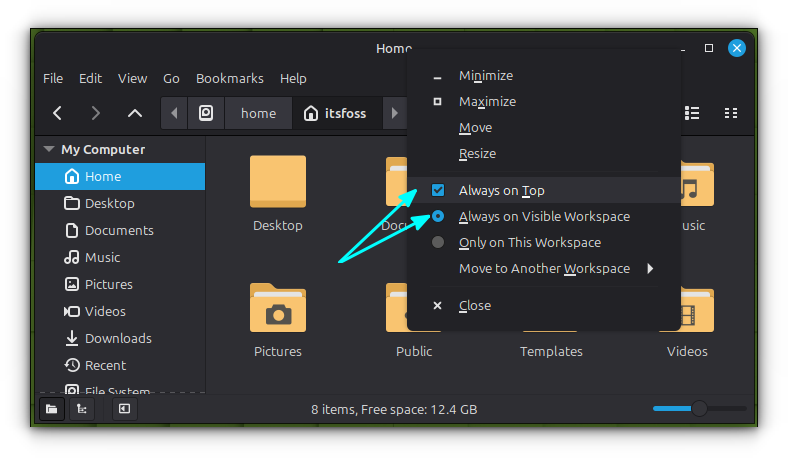
In Linux Mint (Cinnamon desktop), you can right-click the title of a window and enable "Always on Top" and "Always on Visible Workspace". This ensures that the currently open window stays on your current workspace, and will be above every other app window.

You will also find this on other modern desktop environments like KDE Plasma and GNOME as well.

🎋 Fun in the FOSSverse

Can you correctly guess these legendary open source projects?

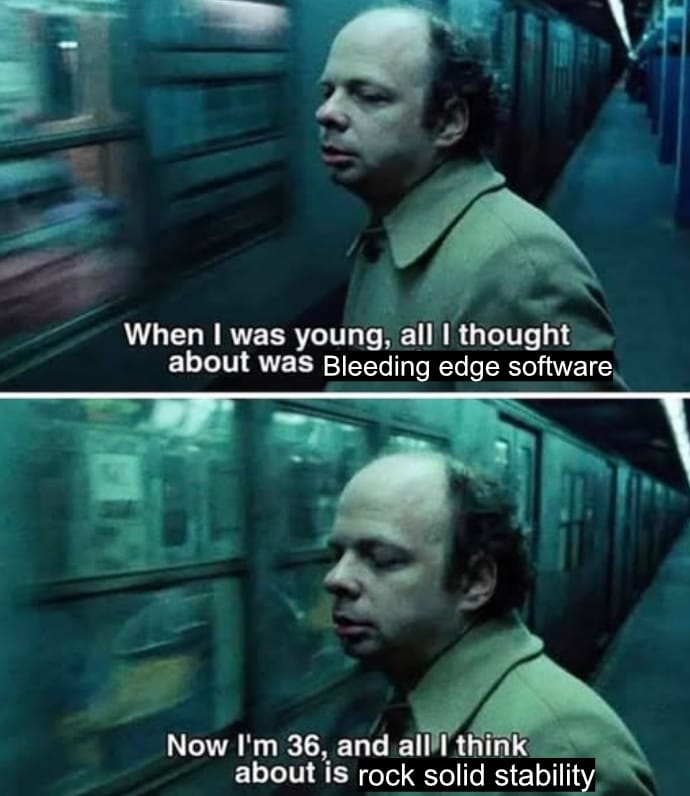
🤣 Meme of the Week: Oh, how the times change. From Arch Linux to Debian.

linux meme on bleeding edge vs stability

🗓️ Tech Trivia: On February 25, 1959, MIT and the U.S. Air Force debuted APT (Automatically Programmed Tool) (I know you thought about the Linux one). It was the world’s first "English-like" programming language for machinery, effectively birthing Computer-Aided Manufacturing (CAM).

🧑‍🤝‍🧑 From the Community: The Apache Software Foundation is looking for people to present at Community Over Code 2026 in Glasgow. Are you up for it?

If that's not your cup of tea, why not talk with a fellow FOSSer about their kernel panic issue.

✇It's FOSS

AI Can Now Easily Unmask Your Secret Online Life (Even If You Use a Fake Name)

Von: Abhishek Prakash

Imagine this: You're on Reddit, Hacker News, or some forum, posting with a silly username like GamerCat2025 or SecretCoderX. You think you are anonymous, and no one knows you and so you can freely express your thoughts.

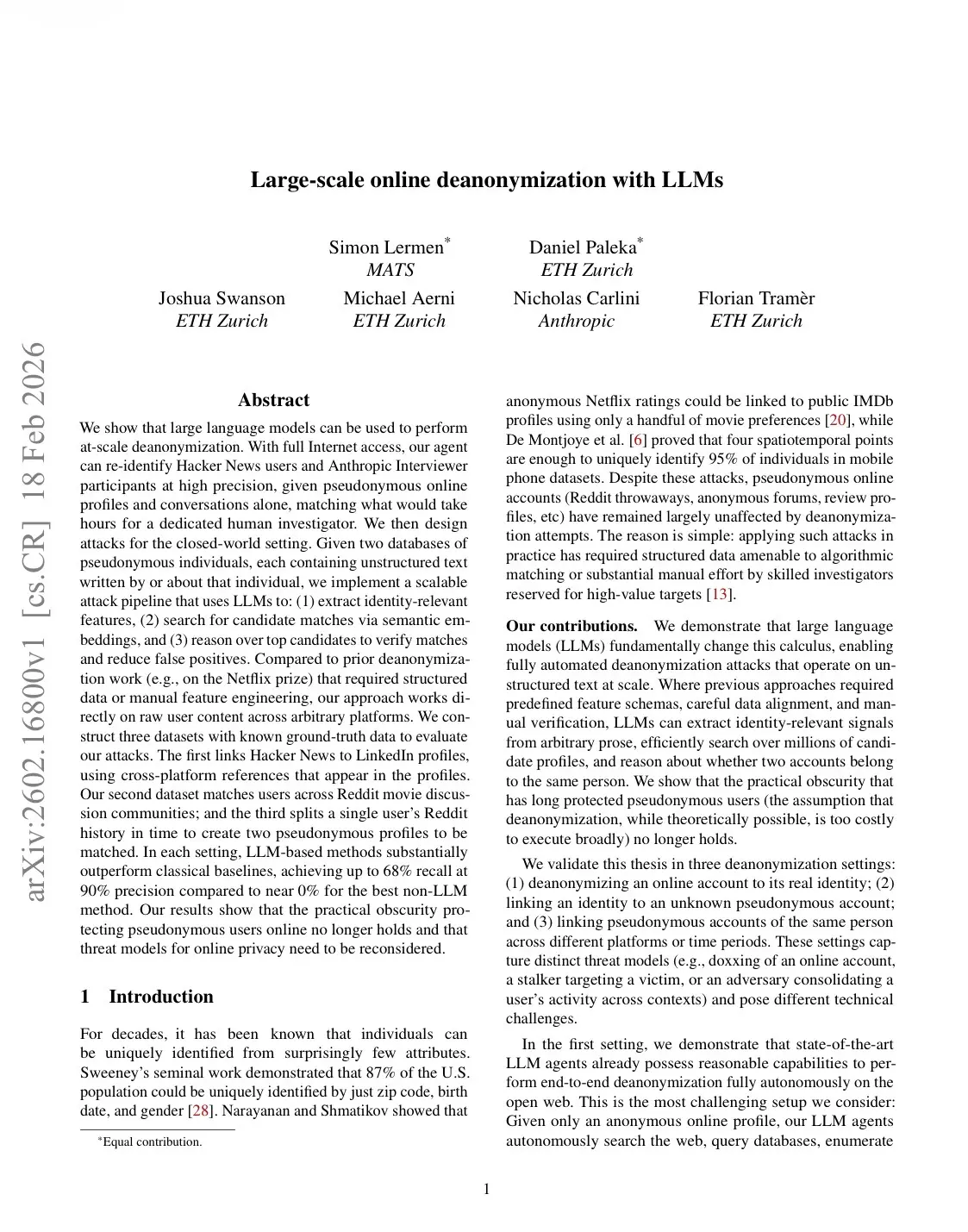
Well, a brand-new research paper just blew that idea apart. It's called "Large-scale online deanonymization with LLMs" which is a fancy way of saying "figuring out the real person behind a secret online name".

Large-scale online deanonymization with LLMs

The researchers include people ETH Zurich and, Anthropic (parent company of Claude), and a research group called MATS and they proved that today's super-powerful AI chatbots can play detective and unmask people way better than ever before.

How does it work?

Think of the AI as a detective like Hercule Poirot or Sherlock Holmes. Only this detective is super fast and super smart. It has read every single post ever written online. Here's how their system works in simple steps:

  1. Read and spot clues: The AI looks at your posts and pulls out little hints about you. Things you that are part of your personality. Like it can see that this person talks a lot about coding games in Python, loves Marvel movies, complains about school in Seattle, and types with a certain style.
  2. Search the whole internet: It quietly checks LinkedIn, Google, other Reddit accounts, etc., to find possible real people who match those clues.
  3. Think hard and double-check: The AI reasons like "Is this a match? The writing style is the same, the hobbies line up, the timing fits... yep, 90% sure!"

The researchers called their method ESRC which stands for Extract clues, Search, Reason, Calibrate how sure they are. No human needed; it's all automatic.

Pretty (scary) impressive results

If you think it's all theory, you are going to be disappointed.

On real Hacker News users, the AI correctly linked the secret username to the real person 67% of the time, and when it made a guess, it was right 90%. The paper also states that matching the same person's Reddit posts from different years or groups met with 68% success.

That's not the scary part. The thing is that it costs only upto $4 to check a person. Anyone with a good chatbot (think future ChatGPT or Claude) could do it.

One of the main researchers, Simon Lermen, said it straight:

Could a team of smart investigators figure out who you are from your posts? If yes, these AI agents can likely do the same – and the cost is only going down.

Private life becomes less private

Until now, staying hidden online was pretty easy because it took human experts hours or days. Now? One person (or a bad guy, a bully, a stalker, a company, or even government) can run this on thousands of accounts super fast.

This means that someone could find your real name, school, city, or job from just a few comments. Stalkers or bullies could dox you. Companies could secretly link all your accounts and track everything you do.

The old idea that "if I use a fake name, I'm safe" doesn't work anymore. It's the end of practical obscurity. Meaning you used to be kind of hidden in practice, but not anymore. Welcome to a new kind of 1984!

✇It's FOSS

This is Probably the Best Video Downloader App (And it is Free and Open Source)

Von: Abhishek Prakash


If you are looking for a free video downloader that just works on Linux, Windows or macOS, VidBee is the ideal choice here.

✇It's FOSS

8 Years Later, Linux-based AsteroidOS 2.0 is Here to Add New Life to Your Old Smartwatch

Von: Abhishek Prakash


The AsteroidOS 2.0 release aims to provide a stable, beautiful base for people who want an open smartwatch today, and an interesting project for developers who want to experiment, learn and contribute.

✇It's FOSS

FOSS Weekly #26.06: Bash Manual in Epstein Files, Linux after Linus, Nano like Editors, France Takes on Big Tech and More

Von: Abhishek Prakash


Your weekly assortment of FOSS news, Linux tips and open source tools.

✇It's FOSS

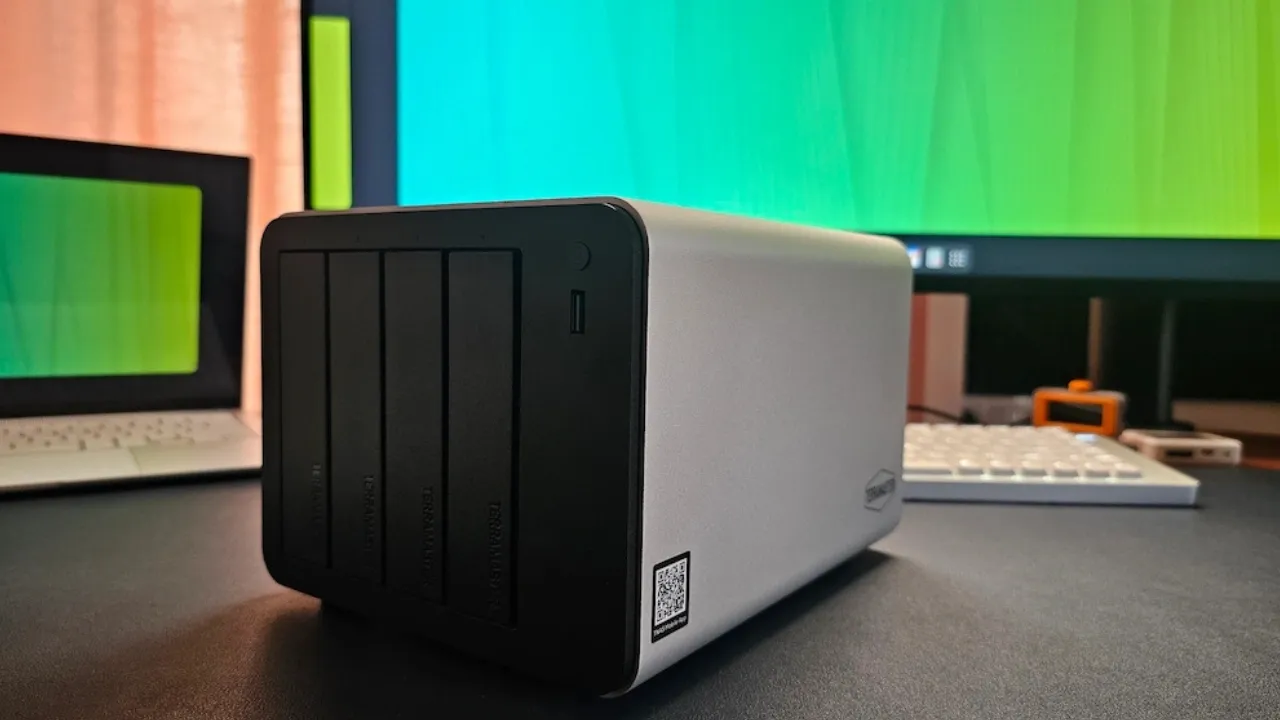
I Tried the TerraMaster F4-425 Plus as My First NAS; Here’s What I Liked (and Didn’t)

Von: Abhishek Prakash


Thinking about your first NAS, too? Here’s my hands-on TerraMaster F4-425 Plus review covering setup, performance, software, and limitations.

❌